Steadfast and loyal League Championship winner.
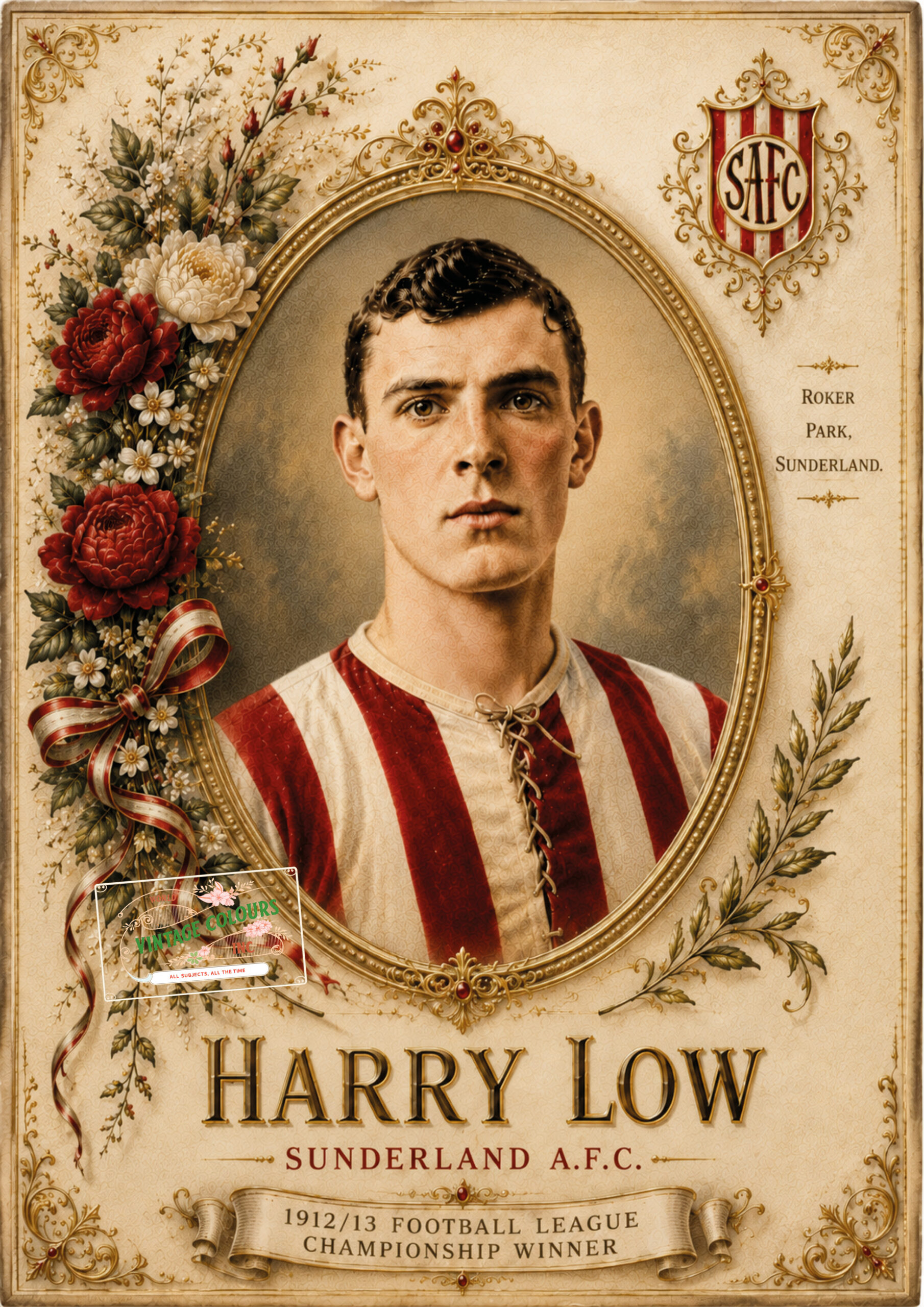
Harry Low (1882–1920)
https://www.ebay.co.uk/itm/257735192841
Few players better embodied the qualities of loyalty, consistency and quiet determination than Henry Forbes “Harry” Low, one of Sunderland’s finest left halves of the Edwardian era. A key member of the side that captured the Football League Championship in 1912/13 and reached the FA Cup Final in the same season, Low enjoyed a distinguished career on both sides of the border before his life was tragically cut short at the age of just thirty-eight.
Born at Oldmachar, Aberdeen, on 15 August 1882, Low was raised in a family for whom football was very much a way of life. His elder brother John played at centre half for Orion, while his younger brother Wilf would later establish himself with Aberdeen, Newcastle United and Scotland. The family’s footballing tradition continued into the next generation through his nephew Norman Low, who enjoyed a successful playing career before becoming a respected Football League manager.
Low began his senior career with Orion in 1901 before joining the newly-formed Aberdeen Football Club in July 1903. The Dons were still in their infancy, having recently been created by the amalgamation of three local clubs, and Low quickly became one of the outstanding figures in their early history. Making his Scottish League debut against Stenhousemuir in September 1903, he developed into an accomplished left half whose calm distribution, intelligent positional play and tireless work-rate made him one of the finest players in Scotland.
His performances helped Aberdeen establish themselves in the Scottish First Division, while honours followed with victory in the Aberdeenshire Cup and two Fleming Charity Cups. Between 1903 and 1907 he made over one hundred first-team appearances and scored more than twenty goals, an impressive return for a player operating in the half-back line. Contemporary observers recognised his immense promise. The Aberdeen Evening Gazette wrote in November 1904 that “Harry Low, left-half, like his vis-à-vis on the right, comes of a family of players, and has a future before him.” It was a prediction that would prove entirely justified.
By the spring of 1907 Aberdeen supporters fully expected Low to sign a new contract, but his consistently outstanding performances had attracted interest from south of the border. Sunderland secured his signature in May 1907 for a fee of approximately £400, a considerable sum at the time and one that reflected both his ability and reputation.
His Football League debut came against Manchester City at Roker Park in September 1907 in a disappointing 5–2 defeat, but any concerns quickly disappeared as he established himself as an automatic selection. Standing just 5 feet 8 inches tall, Low relied less upon physical stature than anticipation, composure and impeccable judgement. An excellent tackler and a cultured passer of the ball, he possessed the stamina to cover immense ground and frequently contributed in attack, adding goals from midfield at a time when such contributions were relatively uncommon.
Over the next eight seasons he became one of Sunderland’s most dependable performers. The club finished third in the First Division in both 1908/09 and 1910/11 before reaching the pinnacle of English football during the memorable 1912/13 campaign. Playing under Bob Kyle, Low was an integral member of the side that secured Sunderland’s fifth Football League Championship, confirming the club’s place amongst the dominant forces of the pre-war game.
That same season also saw Sunderland reach the FA Cup Final at Crystal Palace. Low’s loyalty to the club was demonstrated in remarkable fashion when he withdrew from the Scotland squad for an international against Ireland in order to play for Sunderland in the replay of the FA Cup semi-final against Newcastle United. It was an extraordinary decision that reflected his commitment to his club above personal honours. Sunderland defeated their local rivals to reach the Final, although defeat by Aston Villa denied Low the opportunity to complete a famous League and Cup double. Sadly, having sacrificed the chance of international recognition, he was never selected for Scotland again and therefore remains one of the finest uncapped Scottish players of his generation.
Between 1907 and the suspension of competitive football in 1915, Low made 228 appearances for Sunderland, scoring 39 goals and helping the club also lift the Newcastle & Sunderland Hospitals Cup on two occasions. His consistency over so many seasons earned enormous respect from supporters and opponents alike.
Like so many footballers of his generation, Low’s playing career was interrupted by the outbreak of the First World War. He initially continued to play wartime football, including appearances for South Shields, before volunteering for military service. On 15 February 1917 he enlisted in the Royal Navy as Ordinary Seaman Henry Forbes Low (Service Number J66903). Following his initial training at HMS Victory I in Portsmouth, he was posted to HMS Dido, an Eclipse-class protected cruiser serving as a depot ship for destroyer flotillas based at Harwich. Football remained an important part of naval life and Low captained the ship’s football team, his reputation ensuring that his sporting talents continued to be recognised even while in uniform. Family recollections recall his wife taking numerous pairs of football boots to the ship for the team. After returning to HMS Victory I, he was honourably discharged having been wounded during his service.
With peace restored, Low retired from professional football in May 1919 and embarked upon a new career as landlord of The Fort public house in Monkwearmouth. Situated in the heart of one of Sunderland’s busiest industrial districts, the establishment became a popular meeting place for miners, shipyard workers and football supporters. It appeared that a successful second career lay ahead.
Tragically, fate had other plans. In September 1920, after attending a football match at Roker Park, Low contracted pneumonia. His condition deteriorated rapidly and he died at his Sunderland home on 26 September 1920, aged only thirty-eight. His passing was widely mourned in both Scotland and the North East of England. Newspapers in Aberdeen lamented the loss of one of the city’s greatest footballing exports, while Sunderland supporters remembered one of the club’s most faithful servants.
He left behind his wife Jennie and four children—Kathleen, Harry, Gordon and Maurice. In later years his three sons would all serve during the Second World War and thankfully returned home safely. His younger brother Wilf, himself a distinguished footballer with Newcastle United and Scotland, also met an untimely end when he died in 1933 after being struck by a motor car.
Harry Low may never have won the international honours his ability merited, but his standing within the game was unquestioned. A Football League champion, FA Cup finalist, loyal servant to two great clubs and a Royal Navy veteran, he represented everything admired in the footballers of the Edwardian era.
More than a century after his death, he remains one of Sunderland’s finest pre-war left halves and a player whose contribution to the club’s history deserves to be remembered alongside the greatest names ever to wear the famous red and white stripes.