The original World Club Championship.
Long before the European Cup, UEFA competitions or a FIFA Club World Cup, the leading football clubs of England and Scotland were already meeting in matches intended to establish supremacy between the two great footballing nations of the age. These encounters became variously known as the Football World Championship, United Kingdom Championship, International Club Championship or, in contemporary newspapers, simply the Championship of the World.
Before League football existed, this naturally meant meetings between the winners of the English FA Cup and Scottish Cup. After the Football League was established in England in 1888 and the Scottish Football League followed in 1890, there were four possible qualifying honours: the English League Championship, the English FA Cup, the Scottish League Championship and the Scottish Cup. Consequently, championship matches could involve League champion against League champion, cup winner against cup winner or, on occasions, a League champion against the cup holder of the other country.
This distinction matters because prestigious Anglo-Scottish friendlies were common during the period, but merely defeating a famous club from the other country did not make a match a World Championship contest. The status of the participants — and the honours they actually held — was fundamental to the claim.
The origins of the championship
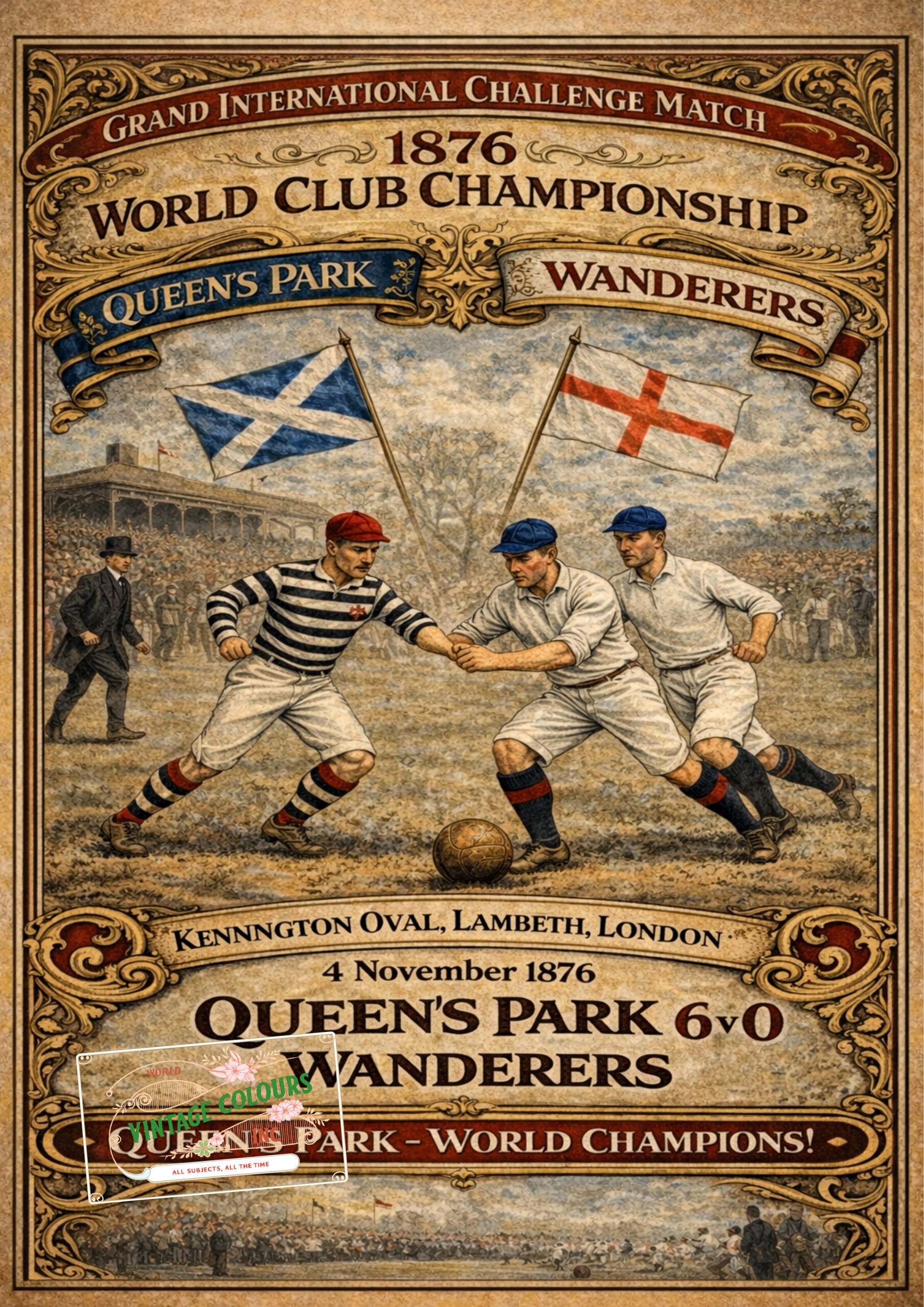
The tradition can be traced back to November 1876, when English FA Cup holders Wanderers met Scottish Cup holders Queen’s Park at The Oval. Queen’s Park won 6–0. In April 1878 Wanderers, again the English cup holders, faced Scottish Cup holders Vale of Leven, who won 3–1, while in December 1879 Vale of Leven defeated English cup holders Old Etonians 5–2 at Hampden Park.
At this stage the matches were not consistently described as being for a British or World Championship. They were, nevertheless, meetings between the holders of the principal football trophies of England and Scotland, establishing the basic principle upon which the later championship claims would rest.
Queen’s Park continued the pattern in the early 1880s, defeating Clapham Rovers and then overwhelming Old Carthusians 8–0 at Hampden in January 1882. Contemporary reports covered these matches in considerable detail but did not present them as contests for a formally recognised championship.
That began to change in September 1883. Scottish Cup holders Dumbarton met English FA Cup holders Blackburn Olympic at Boghead Park and the fixture was described by several contemporary publications as being for the “Championship of the United Kingdom.” Dumbarton won 6–1. Here the concept had become much more explicit: the cup winners of Scotland and England were meeting not merely as two prominent clubs, but as the respective trophy holders of their countries.
Hibernian, Preston and an important distinction
The distinction between a genuine champions-against-champions encounter and an ordinary prestige friendly can be seen particularly clearly in 1887.
Scottish Cup winners Hibernian travelled to Perry Barr in April to face English FA Cup winners Aston Villa. Both clubs had just won their respective national cups, so the fixture satisfied the fundamental qualification: Scottish trophy holders against English trophy holders. Aston Villa won 3–0.
Four months later Hibernian defeated Preston North End 2–1 in Edinburgh in a match which Hibernian advertised as “The Association Football Championship of the World.” That description has subsequently resulted in claims that Hibernian became world champions by beating Preston.
There is a fundamental problem with that claim.
Preston North End were not the champions of England.
Indeed, they were not the holders of either of England’s major honours. There was no English League Championship yet — the Football League would not begin until 1888 — and Preston had not won the FA Cup. They had reached the semi-final of the 1886/87 competition but had been beaten by West Bromwich Albion, who then lost the final to Aston Villa.
The actual English trophy holders were therefore Aston Villa, and Hibernian had already played them in April.
They lost 3–0.
Preston were unquestionably one of the emerging powers of English football and would shortly become the famous “Invincibles”, but reputation was not the qualification. At the time Hibernian played them, Preston were winners of neither the FA Cup nor a League Championship. Calling the fixture a “World Championship” did not alter that fact.
That is why Hibernian’s victory over Preston should be distinguished from the sequence of Anglo-Scottish championship matches between actual trophy holders. If the principle was that the champions or cup winners of England met the champions or cup winners of Scotland, Hibernian had already faced England’s qualifying club that year — Aston Villa — and had been beaten.
Renton and the “Champions of the World”
The most celebrated early example followed in 1888. Renton won the Scottish Cup and West Bromwich Albion won the FA Cup. They therefore met as the current national cup holders of Scotland and England.
On 19 May 1888, at the second Hampden Park, Renton defeated West Bromwich Albion 4–1. Unlike many earlier encounters, this match attracted considerable attention as a contest between the leading trophy holders of the two countries. A small pewter trophy was commissioned and Renton subsequently erected a sign at Tontine Park proclaiming themselves “Champions of the World.”
The description needs to be understood within the football world of 1888. It was not a world championship in the geographical sense that would be understood today. There was no global qualifying competition and football was already developing outside Britain. But organised association football had originated in Britain, and England and Scotland remained the game’s dominant and most established footballing nations. A contest between their trophy-winning clubs could therefore be promoted in the language of the period as determining the leading club side in the football world.
League champions enter the equation
The establishment of the Football League in England in 1888 and the Scottish Football League in 1890 transformed the concept. There were now League champions as well as national cup winners, which meant that several legitimate combinations became possible.
The first English League champions were Preston North End in 1888/89. They also won the FA Cup without conceding a goal, completing the famous Double. Scottish Cup winners Third Lanark subsequently met Preston at Cathkin Park, the match ending 3–3. Unlike Preston’s encounter with Hibernian two years earlier, both participants now held the relevant national honours: Preston were English League champions and FA Cup winners, while Third Lanark were Scottish Cup holders.
Once Scotland established its own League Championship in 1890/91, the most obvious comparison of all became possible: champions of England against champions of Scotland.
And it was during this new era that Sunderland entered the story.
Sunderland and the Anglo-Scottish Championship
Sunderland’s rise was extraordinarily rapid. Having entered the Football League in 1890, the club became champions of England in only its second League season, winning the 1891/92 championship.
The title immediately gave Sunderland the credentials to take part in the Anglo-Scottish championship tradition. Over the following four years the club would win the English League Championship three times and, on three significant occasions, defeat a Scottish club which held one of Scotland’s two principal honours.
The first came in 1892.
Sunderland were the reigning Football League champions and Celtic were the reigning Scottish Cup winners. The clubs therefore met as genuine trophy holders of England and Scotland.
The first encounter took place at Newcastle Road in Sunderland on 5 September 1892. Sunderland won 1–0.
A return was played at Celtic Park in Glasgow on 6 October 1892.
Sunderland won again, this time by 3–0.
Sunderland retained the English championship in 1892/93, and another Anglo-Scottish championship encounter followed in April 1893. This time the opposition was Queen’s Park, winners of the Scottish Cup.
Sunderland had mathematically secured their second successive League Championship only two days earlier. The Glasgow Herald described the fixture as a match between the English and Scottish champions.
At Newcastle Road, Sunderland defeated Queen’s Park 4–2.
Then came the most famous of the three.
“The Championship of the World”
This was therefore the purest form of the Anglo-Scottish championship encounter: the League champions of England against the League champions of Scotland.
The match was played at Tynecastle in Edinburgh on 27 April 1895.
And this time we have particularly compelling contemporary evidence concerning its status.
The Sunderland Daily Echo reported:
“In Edinburgh the match was billed as for ‘The championship of the world’!”
The newspaper then added that, however that description might be regarded, there could be no doubt about the importance of the occasion because Sunderland and Hearts were respectively champions of the English and Scottish Leagues and their encounter was therefore international in character.
Sunderland won 5–3.
This was not a retrospective label invented generations later. “The Championship of the World” was how the match was being advertised in Edinburgh in 1895.
What was the Football World Championship?
The Football World Championship should therefore not be presented as though it were a modern organised tournament. There was no single organising body, fixed annual schedule or universally accepted format. But nor should the contemporary concept simply be dismissed because Victorian football did not organise itself in the manner of the modern game.
The underlying principle was remarkably straightforward. The champions or national cup winners of England played the champions or national cup winners of Scotland. Before League football, that normally meant the respective FA Cup and Scottish Cup holders. After national League competitions had been established, League champions could also meet each other or the cup holders from the other country.
Not every Anglo-Scottish friendly qualified. A famous name was not enough. A club needed to possess the sporting credentials upon which the championship claim rested.
That is why Hibernian’s 1887 victory over Preston North End, despite being advertised by Hibernian as a World Championship, is problematic: Preston had won nothing which entitled them to represent England as its champion club. The actual FA Cup holders were Aston Villa — and Aston Villa had already beaten Hibernian 3–0.
By contrast, Sunderland’s three victories fit directly into the established Anglo-Scottish championship tradition.
In 1892, English League champions Sunderland defeated Scottish Cup winners Celtic.
In 1893, English League champions Sunderland defeated Scottish Cup winners Queen’s Park.
And in 1895, English League champions Sunderland defeated Scottish League champions Heart of Midlothian in Edinburgh in a match explicitly advertised there as being for “The Championship of the World.”
Those three encounters form a remarkable and largely forgotten part of Sunderland AFC’s early history.
They belong to an era when there was no European Cup and no FIFA Club World Cup; when the boundaries of organised football barely extended beyond the competitions which had grown up in Britain; and when the champions of England and Scotland could meet to answer one of the simplest questions in football:
Who was the best of them all?

