
The Roker Wing speculates why the club changed its colours.
Why did Sunderland Association Football Club abandon its original blue shirts for the now-famous red and white?
The precise reason was never recorded in a surviving club minute, but the evidence that remains — social, civic, and symbolic — allows us to draw a clear and logical conclusion. The colours evolved with the club itself, and the final adoption of red and white almost certainly owed something to the heritage of the County Palatine of Durham and the ancient colours of St Cuthbert’s Banner.
The Blue of Blue House Field (1880–1884)
When the Sunderland & District Teachers’ Association Football Club was founded on 25 September 1880, it was a small fraternity of schoolmasters who played their first matches on Blue House Field at Hendon.
In both practicality and poetry, blue was the natural choice: dark enough to hide the Hendon mud, economical to obtain, and in harmony with the name of their field. As later writers have wryly noted, “you could hardly play at Blue House Field in green.”
Founder James Allan, a Scotsman educated at Glasgow, would also have known many Scottish clubs who wore blue, reinforcing the association. The colour represented learning, order, and respectability — the virtues of the teaching profession.
For four seasons the “men in blue” were a familiar sight on that open patch of ground by the sea. The Northern Echo wrote approvingly:
“At Hendon the schoolmasters, in their blue flannel, show uncommon order and civility. Their play is as neat as their dress.” — (Northern Echo, November 1880).
Red Stockings and Ambition (1884–1885)
By 1884–85, playing at Abbs Field, Fulwell, the club had grown ambitious. The official season ticket of that year lists the colours as blue shirts, blue shorts, and red stockings — the first touch of red in Sunderland’s story.
The Sunderland Daily Echo remarked that “the Association Club, in their blue and red attire, present a gallant appearance.” The splash of colour was both practical — aiding visibility — and symbolic of new confidence as Sunderland became a leading side in the county.
Red and White Halves (1885–1887)
When professionalism was legalised in 1885, Sunderland’s horizons broadened. The side that had begun as a teachers’ pastime was now becoming a major competitive force.
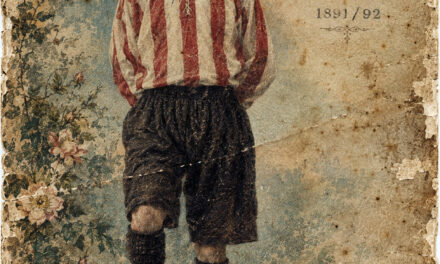
The committee replaced the old blue with red-and-white halved shirts, dark shorts, and red stockings. The pattern was fashionable, easily obtained from outfitters such as Ben Crook & Sons, and far more striking to the paying crowds now attending Abbs Field.
The Northern Echo observed:
“The Sunderland men, in their new red and white shirts, looked every inch a professional side.” — (Northern Echo, November 1885).
The Stripes of Newcastle Road (1887–1888)
The decisive change came with the move to Newcastle Road in September 1887.
For the grand opening against Darlington St Augustine’s, the team appeared in red-and-white striped shirts, white knickers, and red stockings. The Sunderland Daily Echo called it “a costume as neat as it is distinctive.”
Stripes were practical — flannel in that pattern could be ordered cheaply in bulk — but the colours themselves resonated far beyond tailoring convenience.
Red and white were the traditional colours of Durham, long associated with St Cuthbert’s Banner, the ancient red cross on white carried from Durham Cathedral in battle and ceremony. In Victorian County Durham these colours appeared on military facings, civic bunting, and local emblems; they symbolised courage, purity, and faith.
There is no surviving record of the Sunderland committee formally invoking the saint’s banner, but the connection would have been obvious to contemporary eyes. When the Northern Echo reported that “The red and white of Sunderland has a brightness befitting the foremost club in the County Palatine,” — (Northern Echo, October 1887), readers would have recognised the allusion immediately.
It is therefore logical — though not provable — to conclude that the adoption of red and white was in due deference to the county’s historic colours and the symbolism of St Cuthbert’s Banner.
Why the Colours Endured
Once worn, the red and white stripes never disappeared. They were distinctive, affordable, and already steeped in local meaning. By 1890, the Athletic News could say: “Wherever football is played, the red and white of Sunderland is known as the mark of skill and fair conduct.”
The new colours perfectly captured the spirit of a town rising in industry and ambition — red for vigour, white for fairness — the values of the shipyard and the schoolroom combined.
Conclusion
The journey from blue to red and white mirrors Sunderland’s own evolution.
The blue of the Teachers’ era honoured both the club’s profession and its first home at Blue House Field.
The red and white that replaced it reflected a broader identity — civic pride, professional ambition, and the centuries-old colours of County Durham under St Cuthbert’s Banner.
We cannot say with absolute certainty that the saint’s banner directly inspired the change, yet the circumstantial evidence makes it a logical and fitting conclusion.
In adopting red and white, Sunderland AFC quite literally put on the colours of its county — colours that have flown proudly ever since.