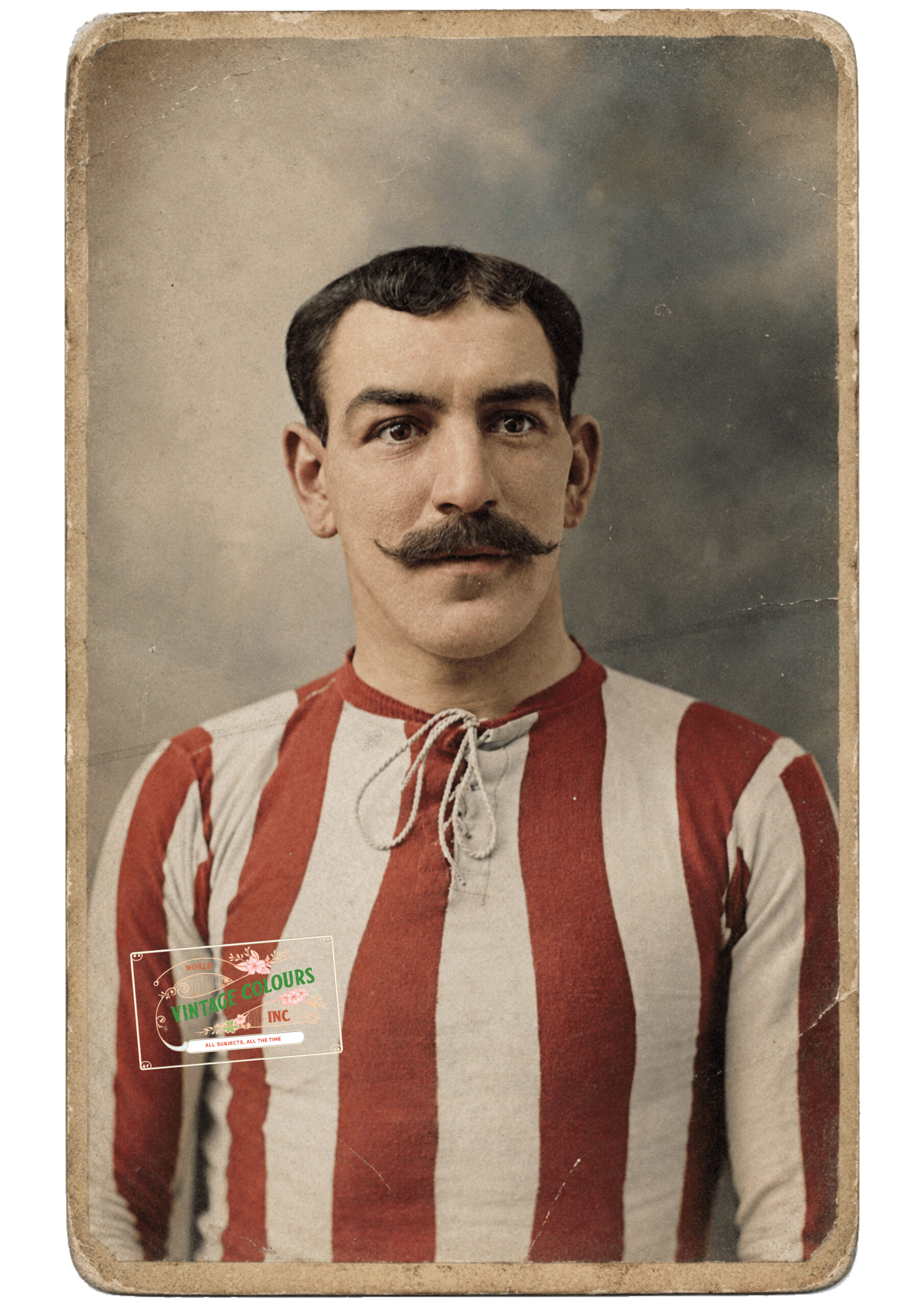
The original “Kevin Ball”.
Few players embodied the spirit of early twentieth century football quite like Charlie Thomson. A commanding presence on the field and an inspirational leader off it, Thomson became one of the great captains of both Heart of Midlothian F.C. and Sunderland A.F.C. during a remarkable career that stretched from the closing years of the Victorian era into the aftermath of the First World War.
Born in Prestonpans on 12 June 1878, Charles Bellany Thomson first played local football in East Lothian before earning a move to Hearts in 1898. Initially used as a centre-forward, he quickly established himself as a powerful and intelligent footballer with an imposing physique and fierce competitive streak. Thomson played in attack during the 1901 Scottish Cup Final, scoring as Hearts defeated Celtic 4–3 in one of the great finals of the era. Over time he dropped deeper into the side and eventually made the centre-half position his own following the departure of Albert Buick in 1903.
It was in defence that Thomson truly flourished. Strong in the tackle, superb in the air and blessed with tremendous stamina, he became the heartbeat of the Hearts side. Supporters admired not only his footballing ability but also his leadership qualities, and he soon inherited the club captaincy. Under his guidance Hearts enjoyed one of the most successful periods in their early history, including victory in the 1906 Scottish Cup Final against Third Lanark. Although injury prevented him from leading the side in the following year’s final, Thomson’s influence on the club had already become immense. By the time he left Tynecastle he had made more than 200 appearances and scored 48 goals, an impressive return for a player who spent much of his career in defence.
His performances for Hearts also brought international recognition. Thomson won his first Scotland cap against Ireland in 1904 and quickly became one of the national side’s most respected figures. Over a ten-year international career he collected 21 caps, 13 of them as captain, a remarkable achievement in an era when Scotland possessed an abundance of outstanding players. Renowned for his coolness under pressure, Thomson also developed a formidable reputation as a penalty taker, with many of his goals coming from the spot.
In 1908 Sunderland secured his signature in a joint transfer deal with goalkeeper Thomas Allan. The combined fee of £700 caused considerable discussion at the time, as Football League regulations technically imposed a transfer limit of £350 per player. Whatever the financial arrangements, Sunderland knew they had acquired a footballer of exceptional quality. Thomson immediately became club captain and one of the dominant personalities in English football.
At Sunderland he played alongside celebrated names such as goalkeeper Leigh Roose and prolific forward George Holley, helping to turn the club into one of the strongest sides in the country. One of the most famous moments of Thomson’s Sunderland career came in the astonishing 9–1 victory over rivals Newcastle United at St James’ Park, a result that entered football folklore on Tyneside.
Thomson’s character was equally evident away from the pitch. In 1910 he found himself at the centre of one of the game’s earliest corruption scandals when Middlesbrough manager Andy Walker allegedly offered Sunderland players money to lose a crucial league match. Thomson refused outright and reported the approach to Sunderland officials. The subsequent Football League investigation resulted in lifetime bans for Walker and Middlesbrough chairman Thomas Gibson Poole, while Thomson’s honesty greatly enhanced his reputation throughout the game.
The peak of his Sunderland career arrived in the 1912–13 season when he captained the club to the Football League championship.
Sunderland nearly completed a famous league and cup double, only to lose narrowly to Aston Villa in the 1913 FA Cup Final. Thomson’s fierce duel with Villa forward Harry Hampton became one of the talking points of the match, with both players later suspended following a bruising encounter that perfectly reflected the uncompromising nature of football in that era.
Even as age caught up with him, Thomson remained an influential figure. During the First World War he reportedly returned to his trade as a baker while attached to the Italian Army in a support capacity. He finally retired from football in 1919 at the age of 41 after making more than 260 senior appearances for Sunderland.
Thomson later returned to Scotland, where he became a publican. He died in Edinburgh on 6 February 1936, but his reputation endured long afterwards. To Hearts supporters he was remembered as a courageous and inspirational captain who helped deliver Scottish Cup glory. To Sunderland fans he remained the commanding leader who guided the club to the English championship. Above all, Charlie Thomson represented the rugged determination, sportsmanship and leadership that defined football’s golden Edwardian age.