A legend never dies
From Hendon to Immortality
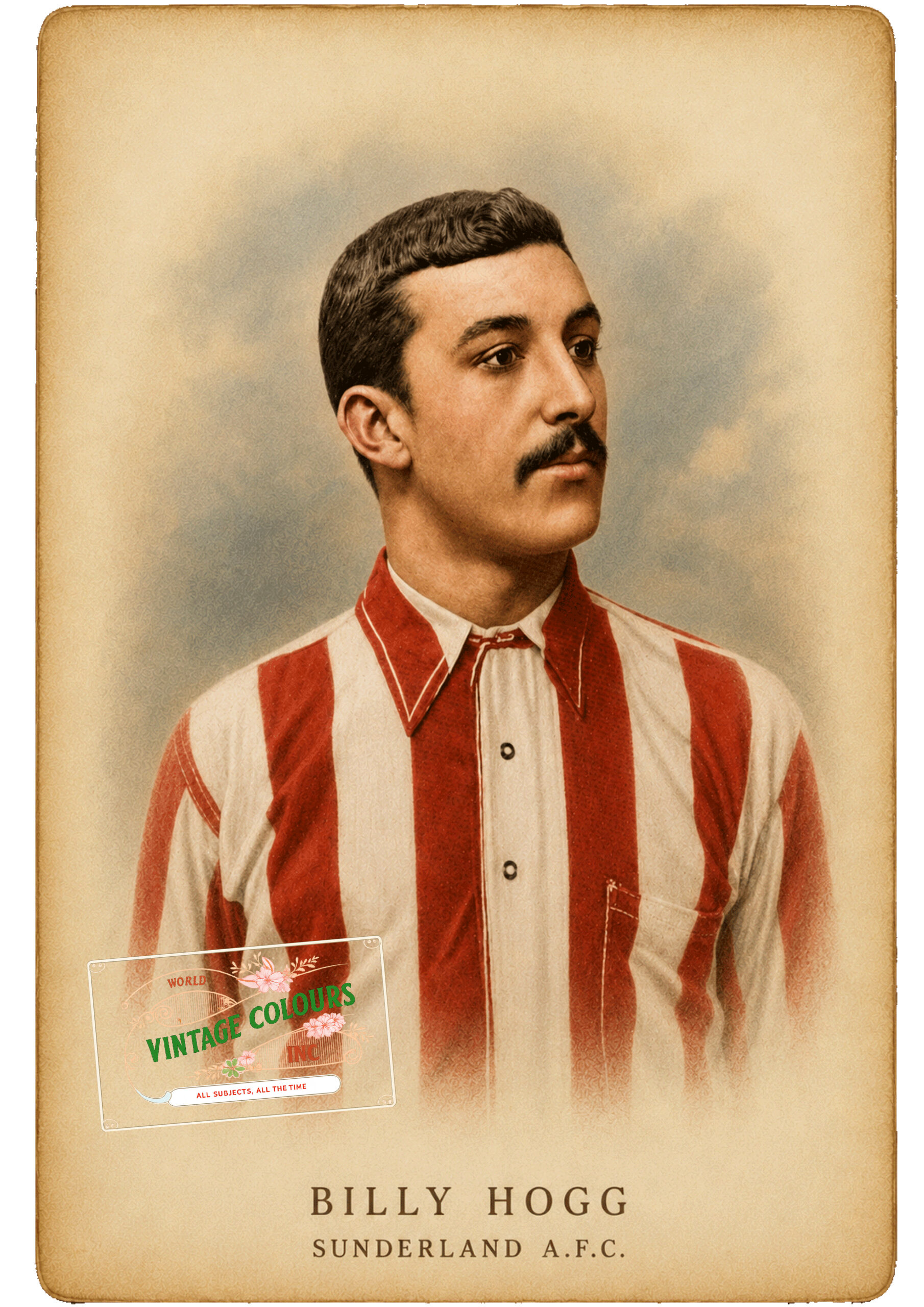
Billy Hogg was born in the shipbuilding heart of Hendon, Sunderland, on 29 May 1879 — a child of iron, salt, and smoke. His father, John, worked as a fitter; his mother, Catherine, ran a busy household in an era when Sunderland’s skyline was ruled by cranes and masts. The game that would define Billy’s life was already beginning to define the town.
When the Hoggs moved north to Heaton, Newcastle-upon-Tyne, young Billy found himself living opposite the ground of Newcastle East End, the club that would soon merge to become Newcastle United. Football was no longer something distant and grand — it was literally across the street. Whether the tale is true or not, locals later claimed the boy once stood on the touchline and watched Alec White score seven goals in East End’s legendary 19–0 victory in 1888. What is certain is that Billy learned early what passion, noise, and belonging looked like.
He was a fine all-round sportsman, good enough to take seven wickets for no runs in a cricket match for Backworth in the Tyneside League, but football had his heart. He played for Walkergate Rangers, Rosehill, and later Willington Athletic up in Howden. He was quick, two-footed, and possessed that rare knack of thinking faster than the man marking him. Scouts soon noticed. In October 1899, Sunderland came calling, offering the twenty-year-old a chance to play for the club of his birth.
A Wearsider Once More
Hogg signed professional forms and was handed his Football League debut on 2 December 1899 against Notts County at Roker Park. Sunderland won 5–0, and the lad from Heaton marked his first appearance with a goal. The Newcastle Daily Journal called it “a debut to remember, the youngster striking the ball with the poise of an old hand.”
He didn’t have to wait long for a second taste of glory. Three weeks later came his first Tyne–Wear derby, played before twenty thousand people at St James’ Park. Sunderland came from behind to win 4–2, and Hogg’s pace and crossing on the right were a constant menace. By the end of that first season, he had scored eleven goals in twenty-two games — remarkable numbers for an outside-right.
The 1900–01 campaign made him indispensable. Sunderland finished second, and Hogg played in every league match, scoring nine goals. But it was 1901–02 that crowned him a champion. In a forward line which included such stars as George Holley (inside right); Arthur Brown (centre forward); Jimmy Gemmell (inside left) and Arthur Bridgett (outside left) Billy was outstanding. He missed six games through injury but still scored ten as Sunderland won the Football League by three points over Everton. He had arrived — a title winner at twenty-two.
England and Tragedy
That season brought another honour: a call-up for England. Hogg made three appearances in the 1902 Home International Championship, representing his country against Wales, Ireland, and Scotland.
Against Scotland, the game would be remembered for tragedy rather than football. Fifty-one minutes into the game at Ibrox Park, a newly built stand gave way, killing twenty-five spectators and injuring hundreds. The players, Hogg among them, were ordered to continue; the match ended 1–1.
The Football Association later declared it void, and the replay at Villa Park saw the gate receipts donated to the disaster fund. Hogg, ever modest, never spoke much about that day, but he played in the rearranged match too.
He also played centre forward for the English League against the Scottish League at St James Park. England won 6 v 3 with Hogg scoring a hat trick. One of them was a penalty which Hogg had to take 3 times; netting each time but seeing his kicks twice disallowed for infringements.
Master of the Wing
By 1903, Hogg was one of the finest forwards in England. His play combined pace with thought. The Athletic News wrote admiringly that he had “that rare gift of finishing what he starts.” In one September match against Notts County, he “netted with a long shot that comprehensively beat the custodian,” while the Newcastle Journal described how “Hogg fired in a glorious shot that was going straight for goal until Evans turned it round the post with splendid judgement.”
He could also be volatile. On 22 October 1904, in a 2–0 win over Sheffield Wednesday, he missed a penalty, scored Sunderland’s second, and was then sent off — a chaotic afternoon that newspapers gleefully called “one of the season’s sensations.”
But those flashes of temper were part of what made him special. He played with emotion, and the crowd loved him for it. His energy and fierce will to win carried Sunderland through seasons of transition. In 1903 he appeared in Sunderland’s Sheriff of London Charity Shield victory over Corinthians at White Hart Lane — another medal for the collection.
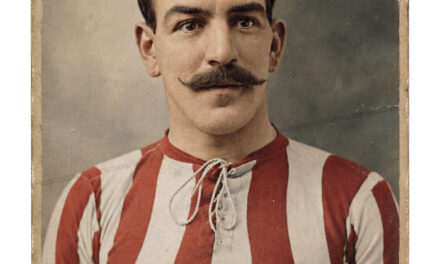
The Journal described him as “a handsome, burly man with the stride of a sprinter and the brain of a schemer.” At five foot nine and close to twelve stone, he wasn’t a light winger in the modern sense, but once he gathered speed, few could stop him.
Captain and Crowd Favourite
By the middle of the decade, Hogg was as much symbol as player. Supporters adored him; opponents respected him. The Athletic News called him “a craftsman in an age of artisans.” In the 1905–06 season, he led Sunderland’s attack in a 3–0 win at Blackburn, scoring from “a near-impossible angle,” and a week later struck twice in a 7–2 thrashing of Wolves.
In 1908, he was made captain. It was a fitting honour for a man who embodied the club’s spirit. That final season, 1908–09, brought him immortality.
On 21 November 1908, he scored a hat-trick in a 4–1 victory away to Woolwich Arsenal. Two weeks later, he did it again — this time in a match that would enter Sunderland legend forever.
The 9–1 Derby
5 December 1908, St James’ Park. Newcastle United versus Sunderland. It was expected to be close. It was not.
Hogg scored three goals in a 9–1 victory — a record that stands to this day. George Holley scored three of his own, Arthur Bridgett added two, and Jackie Mordue finished the rout. The Athletic News declared it “football from another world, the Sunderland forwards combining with a precision that bewildered the champions.” The Newcastle Journal admitted, “Even the home supporters joined in the applause.”
For a Sunderland man to score a hat-trick at St James’ Park was — and remains — an act of footballing sainthood.
Hogg also scored a hat-trick away to Woolwich Arsenal the fortnight before the Newcastle game (2 hat tricks in 14 days) and captained Sunderland to third place in the league. His total: 303 appearances, 84 goals — nearly all from the right wing.
When word came that he was leaving for Rangers, tributes poured in. “It is seldom indeed,” wrote one paper, “that the departure of any footballer arouses such feelings of regret.” At a farewell held at the Heaton Social Club, Sunderland’s chairman, Councillor F. Taylor, called him “one of the most popular players in the North of England.”
Rangers and Beyond
In May 1909, Rangers paid £100 for his signature — “undoubtedly the greatest capture made for a very long time,” said the Scottish Referee.
He settled quickly into Scottish football, scoring six times in his first season and helping Rangers to consecutive league titles in 1911 and 1912. He also won the Glasgow Charity Cup with The Gers.
The Referee described his play as “a mixture of English directness and Scottish craft,” while Ibrox fans adored his mannerisms and humour: “His personality, unique mannerisms and happy-go-lucky disposition have endeared him to Ibrox supporters.”
In 1913, nearing thirty-four, he moved to Dundee, scoring 17 goals in 34 matches, then briefly became player-manager at Raith Rovers.
War and Work
War and work changed everything. When the First World War broke out, Hogg returned to Wearside and took up the tools of his trade in the engineering works of R & W Hawthorn Leslie & Company Limited at St Peter’s Newcastle, announcing that he would not play professionally for the duration — only charity games, including guest turns for Newcastle United in 1915 and 1918.
Football, though, never quite let him go. He returned north of the border to help out at Dundee and Montrose.
On retiring from playing football he stayed close to his people as a local licensee at Earsdon and West Stanley; before he took over the management of the Fountain Head Hotel; Frederick Road; Sunderland — the captain behind the bar now, pouring pints for shipwrights and dockers and swapping stories of Holley and Bridgett, his laugh carrying down the lane like a whistle on matchday. The public house became a kind of second dressing room, a place where the old football tales were told and retold until they became folklore.
In 1927 he took over the post of coach at Sunderland AFC which he held for over 6 years. In 1933 he became manager of The Old Mill Inn; Southwick.
He was also a member of Roker Park Bowling Club as well as being a member of a Scottish Lodge of Freemasons; but took no active part in Sunderland freemasonry.
Hogg was twice married and had two sons and three daughters. One of his sons; William; won an Amateur Cup winners medal for Bishop Auckland in 1935; defeating Wimbledon in the final at Ayresome Park; Middlesbrough.
Legacy
Billy Hogg died in Sunderland on 30 January 1937 having undergone an operation at Monkwearmouth and Southwick Hospital the Tuesday before; having been ill for a fortnight. He was aged fifty-seven. He had undergone what appeared to be a successful operation but on the morning of 30 January collapsed and died suddenly. He was buried at Southwick Cemetery on 3 February 1937. A crowd of more than 2,000 people lined the route from The Old Mill to Southwick Parish Church to pay their respects.
He left behind not just medals and memories, but a place in Sunderland folklore that time cannot touch. He had been a champion of England, a champion of Scotland, a gentleman of the game, and a symbol of the club’s early greatness.
It was said of him that “when they cease to play Willie for his football, they may do worse than play him for his appearance.” But it was his football that made him immortal.
Because in Sunderland, a man who scores a hat-trick against Newcastle United — especially one that ends nine-one — never dies.


Hi, this is a comment.
To get started with moderating, editing, and deleting comments, please visit the Comments screen in the dashboard.
Commenter avatars come from Gravatar.