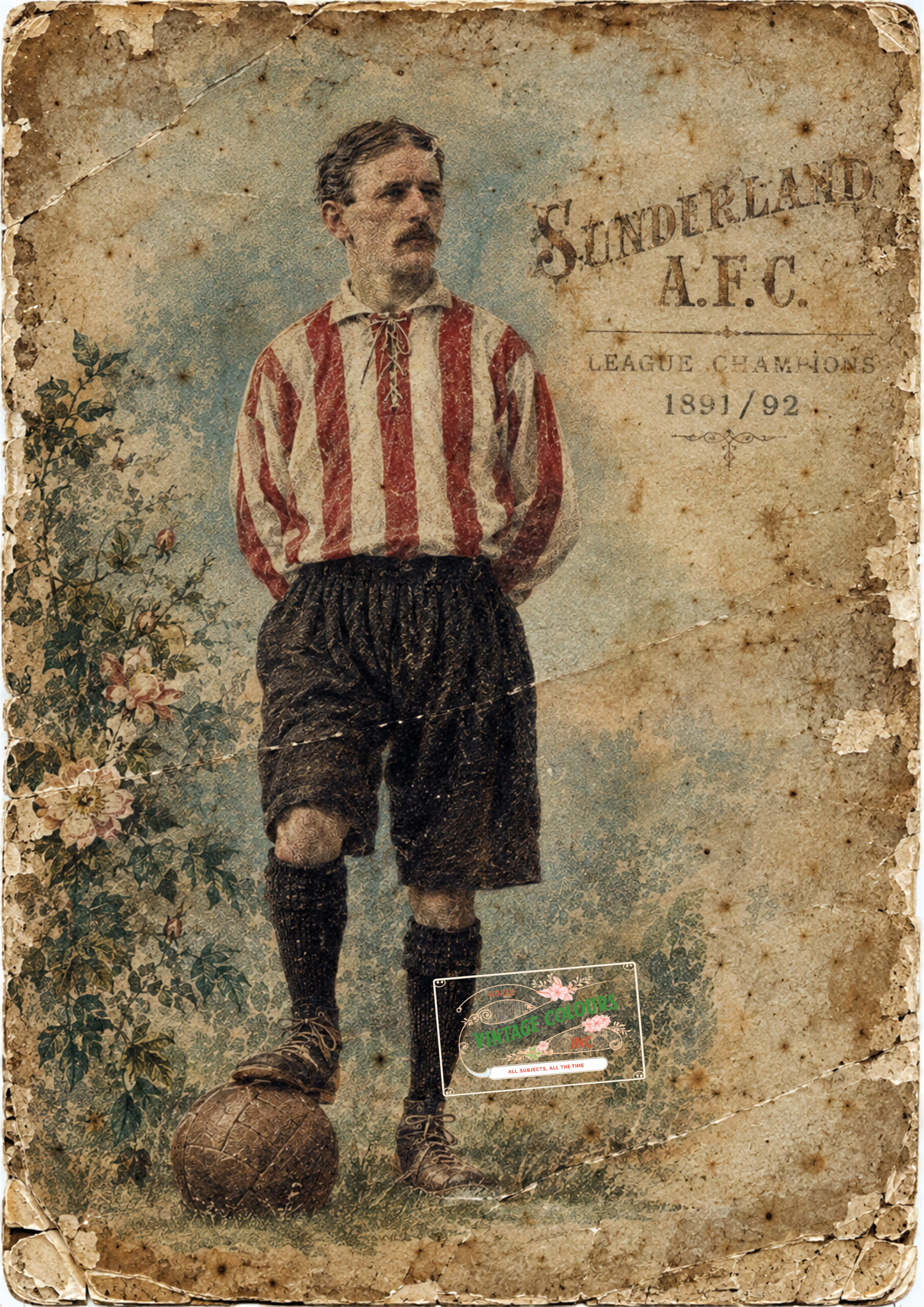
A Victorian Chronicle of the emerging Team of All the Talents
Sunderland AFC: Champions of 1891/92
Chapter I – The Dawn of a New Campaign
The summer of 1891 was a time of expectancy on Wearside. Sunderland Association Football Club had just completed their second season as members of the Football League, and though they finished but seventh in the table, there was a widespread feeling that the club stood upon the threshold of greatness. The Sunderland Echo, never shy in trumpeting the town’s cause, had gone so far as to predict that if the eleven could be held together, “they will humble the pride of the proudest.”
It was bold talk, but there was substance behind it. Sunderland were not as other clubs. In less than a decade since James Allan and his band of schoolmaster friends first put boot to ball, the club had risen from scratch games in the Hendon district to matches against the foremost sides in England and Scotland. Their reputation was now such that William McGregor, the guiding spirit of the League, declared after witnessing them defeat Aston Villa: “There is a talented man in every position.” From that day they bore the proud sobriquet “The Team of All the Talents,” and in the summer of 1891 they prepared to prove worthy of it.
Sunderland’s standing was remarkable given their geography. The club was situated in the far north-east, distant from the Lancashire and Midlands heartlands where the League had been conceived. The long railway journeys south and west were costly, and some directors grumbled that Sunderland’s admission to the League had been a concession to the north-east rather than a boon. Yet distance proved no impediment. In their first season they had beaten Blackburn, Aston Villa, Bolton, and Accrington, and even the docked points in 1890/91 — the result of a clerical error in registering goalkeeper Ned Doig — had not prevented them from finishing respectably. Many shrewd observers believed they were the coming force.
At the club’s helm stood Tom Watson, the secretary. Slight of build, with a neat moustache and quiet competence, Watson combined diligence with shrewd judgement. He had an eye for a player, an ability to coax men from Scotland to Wearside, and the tact to keep them content with board, lodging, and wages.
That summer he added reinforcements of the highest calibre: James Logan, bustling Scottish forward, and Donald Gow, versatile international back. The Echo hailed Gow’s arrival as “one of the most important acquisitions ever made by an English club.”
The supporters were eager to see these new men. The practice matches at Newcastle Road in August were billed almost as public entertainments. Reds played Whites, eleven against eleven, with several thousand paying to watch. Indeed, one trial match on 13 August drew 6,000 spectators — more than many League fixtures in other towns. “The stands were thickly peopled,” wrote the Echo, “and much anxiety was evidenced to get a look at the new men whose names have been rumoured.”
The ground itself had been made ready. Tar and paint had freshened the grandstands; the clubhouse at Ellerslie Terrace had been improved with new baths and a billiard room; the pitch was rolled flat and green. The players, lodged together and fed plain but wholesome food, trained daily under the sharp sea air.
It was in these trial matches that a new law was tested — the penalty kick, passed by the International Board in June 1891. On 25 August Sunderland were granted such a penalty in practice. Jimmy Millar, a clever forward known for his trickery, took the honour. He placed the ball carefully, steadied himself — and sent it wide. The Echo recorded the scene with amusement: “The chance looked an easy one, but whether Millar was overconfident or felt strange to the novel situation, he altogether missed the goal.” Thus Sunderland’s first penalty in history was squandered, though the law would later bring them fortune.
The people of Sunderland, hardened by shipyard and pit, took to football with fervour. The Saturday half-holiday, increasingly observed, gave men freedom to attend. They poured from the foundries and collieries, caps on heads, pipes in mouths, coins jingling for admission. The game was both spectacle and solace. It gave pride to a town often overlooked, a rallying point in the grimy industrial landscape. “When our lads beat the best of England,” said one miner to a reporter, “it gives us heart to go down the pit of a Monday.”
The bookmakers, too, took an interest. Wagers were laid on Sunderland’s chances of a top-three finish, some even daring to back them for the championship. The Echo fanned expectation, speaking of a team without weakness. “Doig is the prince of goalkeepers; Porteous and Gow the stoutest of backs; Wilson, Auld, and Murray a half-back line unequalled; Campbell, Millar, Logan, Hannah, and Scott the most dashing forwards in the kingdom.”
Thus did Sunderland prepare for the season of 1891/92. They had a strong side, a well-run club, a ground fit for purpose, and a town behind them. Their friendlies against local opposition whetted the appetite, but sterner challenges loomed. Before the League campaign began, they were to face an unusual curiosity — a team of Canadians and Americans touring Britain. It promised novelty and entertainment. After that, Wolverhampton Wanderers would arrive for the first serious contest.
The Athletic News, surveying the scene in late August, wrote with prescience:
“The Wearside men, with their new signings and their formidable home record, will take a great deal of beating. If fortune favours them, they may well be champions.”
So the stage was set. The dawn of a new campaign broke, and with it the hopes of a town. Sunderland stood upon the brink of glory.
Chapter II – Visitors from the New World
Before the stern battles of the League could begin, Sunderland and their supporters were treated to an encounter both curious and memorable. On Tuesday, the 1st of September 1891, the Newcastle Road enclosure hosted not Wolverhampton Wanderers nor Preston North End, but a team of colonials — a scratch eleven drawn from Canada and the United States, who had crossed the Atlantic to test themselves against the giants of the British game.
The Novelty of Foreign Visitors
Football was spreading its wings across the Empire and beyond. Canadians, accustomed to ice and snow, and Americans, more familiar with their native gridiron, had taken to Association football in earnest, and in the summer of 1891 an intrepid band of thirty set sail for Britain. They played in Scotland first, against Celtic, Queen’s Park, and Third Lanark, losing more often than not but earning applause for their vigour and pluck. Now, as their English tour commenced, Sunderland were to provide their first opponents south of the border.
Curiosity was immense. The Sunderland Echo, in its preview, declared:
“The Canadians are reputed to play a fast and dashing game, and Sunderland are fortunate in securing the opening match of their English tour. Their opponents may lack the polish of the League sides, but they bring vigour and novelty, and it will be of interest to compare their style with that of our own exponents.”
The people of Wearside flocked to see these strangers from across the ocean. Some three thousand passed through the turnstiles, a respectable midweek crowd, eager to witness history.
The Teams Take the Field
Sunderland, though wary of treating the match too lightly, nevertheless fielded a strong eleven. Doig was in goal, Porteous and Oliver at back, Wilson, Auld, and Gibson across the half-line, and the familiar quintet of Campbell, Millar, Logan, Hannah, and Scott leading the attack. Only Gow was rested.
The visitors, in dark jerseys, were captained by Creighton, with Senkler, Munro, and Kerr among their number. They looked sturdy fellows, tall and broad, though perhaps lacking the polish of their hosts. Still, they received a hearty cheer as they emerged, for novelty always draws affection.
The day was bright, but a stiff gale swept across Newcastle Road, making play difficult. The colonial captain won the toss and elected to take the wind at his backs.
Early Shock, Sunderland Response
To the astonishment of the crowd, it was the visitors who scored first. Senkler, rising above the defence, headed firmly past Doig, who could not prevent the ball from crossing the line. A murmur of surprise rippled around the ground. Could these colonials indeed humble the pride of Wearside?
The answer came swiftly. Sunderland, stung, rallied at once. Campbell, darting through the centre, levelled the score with a shot of characteristic sharpness. Soon after, Millar, “lively as a cricket in a meadow,” as the Echo once styled him, outwitted his man on the flank, crossed to Wilson, whose long punt was seized by Scott and driven low into the net. Sunderland led.
Before the interval, Hannah added a third, to roars of delight. At half-time it was Sunderland 3, Canadians 1.
Canadians Rally in the Wind
Now aided by the gale, the visitors fought valiantly after the break. Munro, described by one journalist as “a player of exceeding dash,” burst through and scored with a fine effort beyond Doig. The crowd, sporting as ever, applauded warmly. For a time, Sunderland’s defence was sorely tested. Porteous cleared desperately, Doig saved brilliantly, and the colonials enjoyed their best spell.
But Sunderland’s class told. Though Kerr in the Canadian goal performed heroics, no further scoring came. The final whistle brought relief to the visitors and applause from the spectators. Sunderland had triumphed 3–2, but the Canadians had earned respect.
Hospitality and Fellowship
Victorian football was as much about fellowship as contest. That evening both teams repaired to the Grand Hotel in Bridge Street, where a dinner was held in honour of the occasion. Tom Watson, genial host, toasted the visitors with warm words:
“Gentlemen, you have crossed the wide Atlantic to grace our fields with your play. We admire your pluck in undertaking such an arduous tour, and we trust that when you return you shall carry with you pleasant memories of Sunderland. Perhaps one day we may be the visitors, should a Good Samaritan arise to stand the expense.”
The room rang with laughter at this sally. Creighton, captain of the Canadians, responded gallantly, thanking the hosts for their kindness and assuring them that, win or lose, the colonials were glad to pit themselves against the best.
Later, the players were conducted to the People’s Palace on High Street West, where amusements and curiosities were laid before them. For men who had braved the Atlantic, the warmth of Sunderland’s welcome was balm indeed.
The Wider Tour
The Canadians’ tour, which lasted months, was a feat of endurance. They played fifty-eight matches, winning fourteen, drawing six, and losing thirty-eight. Against the great powers of the game they had little chance, yet they gained invaluable experience and left behind them memories of courage. At Sunderland they made their mark, and the Echo summed it well:
“The strangers from across the sea gave a capital exhibition and were never daunted, but the superior combination and pace of the Sunderland men carried the day. It was a friendly contest in every sense, and will be long remembered as the day when Canada first challenged the pride of Wearside.”
Meaning for Sunderland
For Sunderland, the match was more than a curiosity. It served as a test of condition, a sharpening of edge, and a display to the faithful that their team was ready for the sterner battles ahead. Campbell and Millar were in form, Hannah’s recovery continued, and Doig was steady as ever. The crowd went home well satisfied.
Within days Newcastle West End would be dispatched in another friendly, and then Wolverhampton Wanderers would arrive for the first great League contest. But the Canadians had left their mark, and Sunderland’s season of triumph began with an echo of the wider world.
Chapter III – Wolves at the Gate
The Canadians had come and gone, their gallant showing cheered and their hospitality warmly returned. Newcastle West End, a familiar local rival, had been overcome in a trial match. Now the serious business of the Football League beckoned. On Saturday, the 5th of September 1891, Newcastle Road played host to Wolverhampton Wanderers — the Wolves of the Black Country — and with them the opening act of what was to prove a most historic season.
A Town on Its Toes
The build-up was keen. By mid-morning, small knots of men were already gathering near Fawcett Street, and by noon the thoroughfares leading toward Newcastle Road thronged with supporters. Boys sold halfpenny programmes, hawkers called their wares, and the air buzzed with speculation. Was this to be the year? Could the Wearside men finally match their promise with sustained success?
By kick-off time, an estimated six to seven thousand were packed into the ground — miners, shipwrights, clerks, and tradesmen, their caps pulled low, their pipes glowing. The stands, freshly tarred and painted in the close season, looked bright beneath the September sun. The pitch, rolled flat and green, offered a perfect surface for fast football. Excitement was tangible, the shouts and chatter carrying far beyond the enclosure.
Wolves Bring Reputation
Wolverhampton Wanderers were no mean opposition. They had finished mid-table in the League’s first seasons, and they carried a reputation for rugged play and dogged defence. Their players were stout sons of the Black Country, used to hard labour and harder contests. Many thought they might check Sunderland’s dashing forwards, and some even tipped them for a surprise.
The Contest Begins
The Wolves won the toss and elected to play with a light breeze at their backs. From the kick-off they pressed, and within minutes Doig was called upon to save a stinging shot. The tall Scotsman, calm and impassive as ever, tipped the ball over with sure hands, drawing loud applause. Moments later Porteous, solid as oak, threw himself into a tackle to halt a Wolves rush.
Yet Sunderland, once settled, began to assert their superiority. Campbell was first to threaten, sprinting through the centre with dazzling speed. Millar, “nimble as a fencer,” teased his man on the wing. Logan, sturdy and direct, shouldered aside his marker. The tide began to turn red and white.
Millar Opens the Account
After a spell of pressure, the breakthrough came. Campbell harried the Wolves defence into error, and the ball broke kindly for Jimmy Millar. Quick as a flash, he drove it home, the net bulging. Hats flew into the air, cheers resounded, and the cry of “Play up, Sunderland!” filled the ground.
Wolves Bite Back
The Wanderers, however, were not to be brushed aside so easily. Midway through the half they forced a scrimmage in front of Doig’s goal, and amid the melee the ball was bundled over the line. For a moment, silence fell on the Wearside crowd. Could the visitors steal a march?
Sunderland Surge
The setback served only to rouse the home side. Within minutes, Sunderland were back on the attack. Logan combined neatly with Scott down the left, the ball was centred, and Campbell struck with deadly precision. The crowd erupted once more. Shortly before half-time, Logan himself added a third, his shot glancing off the post and in. At the break, Sunderland led 3–1, and confidence returned.
The Second Half
Now with the wind at their backs, Sunderland pressed home their advantage. Wilson, Auld, and Murray were magnificent in midfield, snapping into tackles and sending the ball forward with accuracy. Time and again they broke up Wolves’ raids and launched new assaults.
Campbell soon had his second, darting through to score with clinical certainty. The Wanderers’ resistance crumbled. In the closing stages Millar added his name once more to the scoresheet, and the game ended Sunderland 5, Wolverhampton 1.
The Crowd’s Delight
At the whistle, the spectators streamed away in jubilant mood. In the pubs and parlours of Sunderland that evening, the talk was all of the brilliance of the forwards, the solidity of the defence, and the promise of the season ahead. “If they can play thus every week,” said one man to the Echo’s reporter, “none will stand against us.”
Press Reaction
The Sunderland Echo was effusive:
“A finer exhibition of forward play has seldom been witnessed at Newcastle Road. The pace was tremendous, the passing deft, and the shooting true. The Wanderers, game as they were, could make no headway against the magnificent combination of the home side.”
The Athletic News, writing from Manchester, though more measured, still acknowledged Sunderland’s superiority:
“It is plain that the Wearsiders, strengthened as they are by new men, will this season be formidable opponents to all who stand in their way. Their forwards are as swift and skilful as any, and their defence, with Doig at its head, is amongst the stoutest in the country.”
Symbol Beyond the Score
For Sunderland, this opening victory was more than a pair of points. It was a statement of intent, a declaration to the footballing world that the far north-east could no longer be considered a distant outpost. In a sport dominated thus far by Lancashire’s “Invincibles” and Everton’s recent champions, here was a new power rising.
For the town itself, it was a moment of civic affirmation. The miners trudging home from the pits, the shipyard men labouring by the Wear, the clerks in their offices — all felt a thrill of pride that Sunderland had so handsomely begun their campaign.
The Season Opens in Earnest
So the League season was launched. Sunderland, five goals to one against Wolverhampton Wanderers, stood at once among the leaders. Already eyes turned toward the coming clashes with Preston and Everton. The murmurs of summer grew into confident predictions. The cry went up again and again: “Play up, Sunderland!”
And in that September sun of 1891, with hats aloft and hearts full, Wearside believed that the great year had begun.
Chapter IV – The Autumn Charge
The first victory over Wolverhampton Wanderers had sent Wearside home in jubilant spirits, but to prove themselves champions Sunderland needed consistency. The autumn of 1891 brought a succession of contests that would test their mettle, and it was in these weeks that the Wearsiders truly announced themselves as the foremost team in England.
The Forward Line in Full Bloom
From September through to November, Sunderland’s forwards struck terror into every defence. Johnny Campbell, fleet and fearless, was the spearhead, scoring goals with bewildering regularity. Jimmy Millar, quick and crafty, darted along the flanks, tricking his man with deftness. James Logan, sturdy and direct, was the battering ram down the centre. Tom Scott, restless and energetic, harried opponents into error. James Hannah, fit once more after his grave illness, brought guile and experience. Together they moved like the fingers of a hand — distinct yet united, working in perfect combination.
Behind them stood the iron half-back line of Wilson, Auld, and Murray. Their tackling was fierce, their covering relentless, their distribution intelligent. They were the fulcrum upon which the team turned. And should any break through, they met the stone wall of Porteous and Gow, with Doig — tall, steady, magnificent — behind them.
Triumph in Lancashire
September took Sunderland to Blackburn, and there, before a partisan Lancashire crowd, they triumphed. The Blackburn Times admitted, though grudgingly:
“The visitors play with a speed and unity that our men could not match. Campbell is a veritable terror, his shots fierce as thunderclaps.”
The victory silenced doubters who claimed Sunderland could win only on home soil. From Wear to Ribble, it was declared that the Wearsiders were a force.
Accrington and Notts Brushed Aside
Accrington, a sturdy side in claret and white, were next to fall, unable to withstand the ceaseless tide of Sunderland’s forwards. Notts County, meanwhile, came north and were undone by a deluge of goals. A Nottingham paper confessed:
“Never have our men been so utterly outpaced. The rush of the Sunderland forwards was like a tide, wave upon wave, and our defence was washed aside.”
At Newcastle Road, crowds swelled. Ten, twelve, even fifteen thousand pressed in to see their heroes. The terraces rang with cries of “Play up, Sunderland!” Boys kicked rag balls in the streets, dreaming themselves the next Campbell. The colours of red and white were worn with pride on caps and scarves.
Everton Humbled
October brought Everton, the reigning champions. Much was made of their visit, and the gate was immense. The champions were confident, but Sunderland gave them no quarter. Campbell’s pace proved decisive, Doig was impregnable, and the defence ironclad. Sunderland won, and the crown was already slipping from Everton’s head.
The Echo exulted:
“It was a contest worthy of the name. Everton fought stoutly, but the Wearside men swept them aside. There is no finer team in the land.”
Preston’s Pride Tested
Preston North End, still priding themselves upon their “Invincibles” of 1888/89, were also forced to bow. Sunderland’s passing and speed bewildered them. The Preston Herald admitted ruefully:
“They are indeed the team of all the talents. We may not this season withstand them.”
The Growing Reputation
As October closed, Sunderland sat at or near the summit. The Athletic News observed:
“There is a smoothness in the play of Sunderland that is rarely matched. The halves are tireless, the forwards swift as arrows, the backs strong as oak. Against such an array, most sides are found wanting.”
The Echo, more partisan, declared:
“From Doig in goal to Campbell at centre, each man plays with vigour and skill. The town may well be proud, for no finer team exists in the land.”
More Than Football
For the people of Sunderland, these autumn victories meant more than sport. In the pits of Monkwearmouth, in the roaring yards of the Wear, men spoke with pride. “Our lads beat the best of England,” one miner told the Echo, “and it gives us heart to go down the pit of a Monday.” Football was civic pride, a unifying force.
In parlours and pubs, toasts were raised. In schools, boys chalked the names of Campbell and Doig upon slates. Football had captured the town’s imagination as never before.
Winter Approaches
By November’s end, Sunderland had built a formidable record. They had humbled champions and silenced doubters. The forward line was scoring at will, Campbell leading the nation’s charts. Doig was spoken of as the best goalkeeper in Britain. The half-backs were hailed as unrivalled.
Yet winter loomed, with snow and frost to test their resolve. And the Cup, that old silver trophy, was about to begin. Could Sunderland carry their autumn form into the harsh months ahead?
The stage was set for trials of another kind.
Chapter V – Cup Dreams and Winter Hardships
For all the glory of the League, in those days it was still the English Cup that stirred the deepest emotions. To lift the silver trophy, contested since 1871 and revered as the game’s oldest prize, was the ambition of every club and the dream of every supporter. A League crown might proclaim consistency, but the Cup brought romance and immortality. In Sunderland, where football had become the talk of shipyard and pit, the Cup campaign of 1891/92 was awaited with breathless anticipation.
First Round – Notts County Twice Defeated
The draw paired Sunderland with Notts County, one of the game’s senior clubs. On Saturday, the 16th of January 1892, some sixteen thousand crammed into Newcastle Road. The day was crisp, the turf firm, the atmosphere electric.
From the outset Sunderland dominated. Jimmy Millar opened the scoring with a sharp finish, Johnny Campbell added another with his characteristic dash, and James Hannah, beloved of the crowd, made it three. The Echo rejoiced:
“The Wearsiders gave a performance to set the town alight. Their forwards were irresistible, their halves unyielding, and Doig had but little to do.”
Sunderland had triumphed 3–0, and supporters poured into the streets in high glee. Yet controversy followed. County lodged a protest concerning a player’s eligibility, and the FA, ever officious, ordered a replay. Wearside muttered darkly about prejudice from southern administrators.
On 23 January, at Newcastle Road once again, Sunderland replied in the best possible fashion. They swept County aside with even greater ease. Logan scored, Campbell was on target, and Millar completed the rout. The final score: 4–0. The Echo could not resist a jibe:
“Notts County have had two lessons instead of one, and Sunderland march on with heads held high.”
Second Round – Victory at Accrington
The second round, on 6 February, sent Sunderland to Lancashire to meet Accrington at Thorneyholme Road. The claret-and-white hosts, renowned for rugged play, made life difficult. The pitch was heavy, the crowd partisan, and for a time the game was a bruising struggle. But class told. Campbell, Logan, and Millar each found the net, and Sunderland prevailed 3–1. “They can win on foreign soil as well as their own,” wrote the Athletic News.
Third Round – The Stoke Saga
In the third round, drawn against Stoke, Sunderland travelled to the Victoria Ground on 13 February. A large crowd roared the Potters on, and the match became a stern contest. Stoke scored first, Campbell equalised; Stoke led again, Sunderland levelled late on. Extra time was played, but neither side could strike the decisive blow. The final score: 2–2.
A week later, on 20 February, the tie was replayed at Newcastle Road. This time Sunderland were ruthless. From the first whistle they dominated, their forwards sweeping forward in wave after wave. Four goals were scored without reply. The Echo was rhapsodic:
“It was a rout of the stoutest order. Stoke could scarce get into the game, so masterful were the Sunderland men. The crowd went home exultant, speaking of Kennington Oval and the trophy at last.”
Semi-Final – Aston Villa the Barrier
Thus Sunderland reached the semi-final, to be played at Bramall Lane, Sheffield, on 27 February 1892. Their opponents were Aston Villa, who had themselves risen swiftly to prominence in the Midlands. Thousands journeyed from Sunderland, filling trains and crowding the streets of Sheffield. The atmosphere was fevered; it was widely believed that the winner would lift the Cup.
From the start, however, Villa seized the initiative. Before long they led, and though Campbell, ever dangerous, pulled one back, Sunderland could not contain Villa’s pace and power. Goal followed goal, and at the close the score stood Villa 4, Sunderland 1.
The Echo lamented:
“Once more the blessed pot eludes us. Our men were gallant, but Villa were the sharper on the day. It is a cruel fate, for our team had the merit, yet merit alone does not suffice when the Cup is at stake.”
Wearside mourned. Twice in succession Sunderland had reached the semi-final; twice they had stumbled at the penultimate hurdle. Yet there was pride too, for it proved beyond doubt that the club stood among the nation’s elite. As one supporter wrote to the Echo, “Our day will come. If not this year, then next.”
Winter Hardships in the League
While Cup fever gripped the town, the League continued, and the winter of 1892 was harsh. Matches were played in sleet and snow, on iron-hard pitches and in biting winds. Players shivered in heavy jerseys, their hands numbed, their feet bruised by the frozen turf. The Echo described one such contest:
“The men fought not only the foe before them but the elements around them. Hands and feet were benumbed, the ball flew like an unruly spirit in the gale, and still the contest raged.”
Sunderland, however, proved resilient. Wilson, Auld, and Murray never ceased running, closing down opponents and launching attacks. Doig, gloves thick upon his hands, saved bravely when shots flew like bullets. Campbell, despite the bitter cold, contrived to score with unerring regularity. Injuries were few, though James Hannah was nursed carefully after his long illness.
Victories were ground out, often by narrow margins, yet they all counted. By February’s end, though the Cup dream had died at Bramall Lane, Sunderland stood proudly at the head of the League table. Preston pursued, Everton lingered, but the Wearsiders were firm in the lead.
The Double Dream Deferred
Some dared to dream of a double — Cup and League together. That ambition was ended by Villa in Sheffield. Yet the greater prize still beckoned. The League crown, though newer than the old trophy, was coveted fiercely. Sunderland had established their supremacy in the first half of the campaign; now the spring would bring the decisive clashes.
Wearside consoled itself. “The Cup may wait,” said one supporter in the Market Tavern, “but the League we shall have, mark my words.”
Chapter VI – The March to Glory
By late February, as the snows began to melt and the promise of spring showed in the lengthening days, the Football League season of 1891/92 had resolved itself into a duel. Sunderland, that proud eleven of Wearside, stood neck and neck with Preston North End, the once-invincible Lilywhites. Everton and Villa lingered on the fringes, but all eyes were fixed upon the two rivals. The newspapers set the contest as a clash of generations: Preston, the pioneers of combination, versus Sunderland, the “Team of All the Talents,” heirs to their mantle. Each match from March onwards bore the weight of destiny.
Sunderland 4–1 Preston North End (12 March, Newcastle Road)
The first of the decisive battles brought Preston themselves to Newcastle Road. Twelve thousand thronged the ground, packed tight upon the terraces, caps and mufflers warding off the lingering chill. Excitement was feverish: should Sunderland falter, Preston would steal a march; should Sunderland win, the crown would edge nearer.
The match began at furious pace. Preston’s backs, stout and experienced, sought to smother Campbell, but the little Scot was irrepressible. Midway through the half he darted through, ball at his feet, and drove home the opening goal. The roar could be heard across the town. Soon Millar added a second, and though Preston pulled one back, Sunderland surged again. Campbell scored once more, and the Hannah brothers combined cleverly for a fourth. The final tally: 4–1.
The Echo was rapturous:
“The Sunderland men were as the tide, wave upon wave breaking upon the Preston shore, until at last the sea swept over and left them desolate.”
The Athletic News admitted frankly:
“Preston have been dethroned. Sunderland are now the foremost side in the land.”
Derby County 2–3 Sunderland (19 March, Baseball Ground)
A week later came Derby away. The Baseball Ground was heavy, the clay pitch sodden from rain, and the Rams determined to resist. The match was rough, but Sunderland’s class prevailed. Campbell, Logan, and Millar scored; Derby replied twice, but could not equalise. Sunderland triumphed 3–2.
“ No ground is too far, no opposition too stern,” declared the Athletic News. The Wearside men had proven they could conquer even in hostile territory.
Sunderland 2–1 Aston Villa (26 March, Newcastle Road)
The semi-final defeat by Villa in Sheffield still rankled. Now came a chance for revenge. Seventeen thousand crowded Newcastle Road, the largest gate of the season. From the first whistle, the match was fierce. Villa struck first, but Logan equalised with a thunderbolt that shook the rigging. The ground shook with cheers. Then, late in the second half, Campbell broke through and scored the winner. The crowd erupted, caps flung aloft.
The Echo hailed it “the most popular victory of the season.” Sunderland had avenged their Cup loss, and the march continued.
Notts County 1–3 Sunderland (2 April, Trent Bridge)
On 2 April Sunderland travelled to Nottingham to meet their old Cup foes. The home side fought with spirit, but Campbell and Millar once again led the way. Sunderland won 3–1. One Nottingham paper admitted ruefully:
“The visitors are a team of rare powers. They swept us aside with an ease that brooked no reply.”
Darwen 2–5 Sunderland (9 April, Barley Bank)
Darwen, already doomed to finish bottom, could not withstand the champions-elect. Sunderland romped to a 5–2 victory, Campbell and Logan sharing the spoils. The Echo observed:
“The Wearside men made merry, their goals coming as fast as the scorers could be recorded. It was practice rather than contest.”
Sunderland 6–1 Blackburn Rovers (16 April, Newcastle Road)
Now came the match that would decide the championship. Blackburn Rovers, proud winners of five FA Cups, travelled to Wearside. Ten thousand packed the ground, the air chill, the tension palpable.
From the outset Sunderland were magnificent. Campbell, tireless and deadly, struck a hat-trick; James and William Hannah each scored; Millar added another. Blackburn, proud though they were, were humbled 6–1.
Word spread that Preston had lost at Villa Park. Sunderland were mathematically champions. The terraces erupted. Hats were thrown aloft, songs filled the air, and “Play up, Sunderland!” echoed across the ground.
Tom Watson, the secretary, was present at Newcastle Road that day, but such was his nervous agitation that he could not bear to watch the play. He paced the ground anxiously, awaiting tidings. When the news was brought to him that Sunderland had triumphed, his eyes filled with tears. William Perry of the Echo sought words to capture the moment:
“What is the moon like on a bright and clear night?”
“Oh, it is a beautiful sight.”
“Then the Sunderland team was like a full moon shining brilliantly among the Preston stars.”
So Sunderland were crowned champions of England.
Burnley 0–3 Sunderland (23 April, Turf Moor)
Already champions, Sunderland still showed no mercy. Away at Burnley they triumphed 3–0, displaying the professionalism that marked their season.
“Even with the crown secure, they play with the same vigour,” wrote the Athletic News. “Truly a credit to the League.”
Sunderland 4–0 Stoke (30 April, Newcastle Road)
The season ended with Stoke at Newcastle Road. Before a jubilant home crowd, Sunderland ran out 4–0 victors. At the final whistle, thousands surged onto the field, cheering their heroes. The campaign was done: Sunderland, five points clear, champions at last.
Chapter VII – Champions of the Land
When the dust of the campaign had settled and the final whistle of April sounded, the verdict was unarguable. Sunderland Association Football Club, once a fledgling side in the shadow of Lancashire’s powers, now stood alone at the summit. Champions of England, and deservedly so.
The Final Table
The League table bore testimony to their supremacy. Sunderland had played 26 matches, winning 20, drawing 3, and losing only 3. Their goals for stood at a colossal 93, with just 33 against. They had finished five points clear of their nearest challengers, Preston North End, and more than that: they had beaten all the leading clubs, often handsomely.
In an age when the margins were usually fine, Sunderland’s record was astonishing. They had not merely edged the title; they had swept it aside. “They are the best team in the land, beyond dispute,” wrote the Athletic News.
Campbell the Goal King
At the forefront of this triumph stood Johnny Campbell, a centre-forward whose name became synonymous with goals. In League play he netted 30 times in 24 matches — a total that astonished the footballing world. His dash, his sharpness, his unerring shot made him the terror of every defence. The Referee quipped:
“Campbell scores as naturally as other men breathe.”
The people of Sunderland adored him. Boys copied his gait in the back lanes, miners spoke of his prowess at the pithead, and his name was sung in taverns. To this day his feats in that season remain legendary.
The Team of All the Talents
But Campbell was not alone. The brilliance of Sunderland lay in the collective.
- Ned Doig, in goal, was the calm sentry. Tall, imposing, gloved, he saved with certainty. “The prince of goalkeepers,” declared the Echo, and few disputed it.
- Hughie Wilson, John Auld, and Davie Murray, the half-back line, were tireless. They harried, tackled, and distributed with uncanny understanding. Wilson’s long throws were a weapon in themselves; Auld’s tenacity inspired; Murray’s covering was invaluable.
- Donald Gow and David Porteous, the backs, were solid as the Wear shipyards. They stood shoulder to shoulder, repelling attacks with strength and judgment.
- Millar, Logan, Hannah, and Scott, alongside Campbell, formed the most dazzling forward line in England. Millar the trickster, Logan the battering ram, Hannah the schemer, Scott the tireless worker — each contributed. Together they were irresistible.
It was this unity that won them the crown. The Athletic News marvelled:
“They play as though bound by one thought, one spirit. Each knows his part, each executes it, and the whole is a machine of marvellous precision.”
Press Praise
Praise flowed from every quarter. The Sunderland Echo, naturally partisan, could scarcely contain itself:
“From Doig in goal to Campbell at centre, each man has played with vigour and skill. The town may well be proud, for never has a finer team graced the League.”
The Athletic News acknowledged the new order:
“Sunderland have usurped the throne of Preston. They are the heirs of the Invincibles, but with a speed and polish that even Preston in their pomp did not surpass.”
Even the Lancashire Evening Post, though lamenting Preston’s dethronement, admitted grudgingly:
“It cannot be denied: Sunderland are worthy champions.”
The Town’s Rejoicing
The triumph reverberated through Sunderland itself. The town, known chiefly for ships and coal, now had a new badge of honour. “Home of the Champions of England” — such was the boast of Wearside.
Crowds gathered in the Market Square, toasts were raised in taverns, and in the yards men sang as they worked. Children kicked balls with red and white scarves tied round their necks. Football was no longer pastime alone; it was civic pride, the symbol of a town’s ascendancy.
The song rang out, sung to the tune of The Ship That Never Returned:
There is Doig in goal with Porteous,
And Gow the famous back;
Wilson, Auld, and Murray,
Who never feared attack;
Campbell and brave Hannah,
And Logan never slack;
Play up, good old Sunderland,
The best team in the land!
The League’s Homage
The title had been won upon the field, but it was fitting that Sunderland’s supremacy should also be recognised in banquet and ceremony. In early May, representatives of the Football League journeyed north to Sunderland to join in a grand dinner arranged by the club’s directors. The venue was the Grand Hotel on Bridge Street, bedecked with banners of red and white, the tables spread with silver and crystal.
Among the guests were officials from rival clubs, civic dignitaries, and members of the press. It was said that never before had Sunderland hosted such an assemblage of the footballing great. The chair was taken by Mr. J. Allan, founder of the club, and at his right hand sat Mr. William McGregor of Aston Villa, the very architect of the League. Representatives from Preston, Everton, and Blackburn were present, their attendance a mark of respect to the new champions.
The dinner was sumptuous — soup, fish, joints of beef, puddings, all washed down with wine and ale. After the meal, the toasts began.
Mr. McGregor rose, greeted by loud applause. He spoke warmly:
“Gentlemen, it is my pleasure, as one who has seen this League from its birth, to extend our heartfelt congratulations to Sunderland. They have played the game in the spirit it ought to be played, with dash, with science, and with good fellowship. They are worthy champions, and their name shall be inscribed with honour upon our roll.”
The toast to “The Sunderland Team” was drunk with enthusiasm.
Tom Watson, modest as ever, replied. His voice trembled with emotion as he said:
“It is not for me to take credit, but for the men who have laboured week by week, in wind and rain, in snow and frost, and never spared themselves. They are a credit not only to Sunderland but to the League itself. I thank you, gentlemen, on their behalf.”
Johnny Campbell, pressed to say a word, blushed as he stood:
“We have done our best, sirs, and if our play has given pleasure to Wearside, we are content.”
The mayor of Sunderland followed, raising his glass:
“Our shipyards have built vessels that sail the seas, our pits have sent coal across the world, but this year Sunderland has given to England the finest football team in the land. Long may they flourish!”
The room rang with cheers, and the company rose to sing Auld Lang Syne. It was a night long remembered, the formal coronation of Sunderland as champions of England.
Tom Watson’s Triumph
No figure deserved more credit than Tom Watson. Nervous though he had been at the Blackburn decider, pacing anxiously at Newcastle Road, his labours bore fruit. He had recruited wisely, organised astutely, and managed discreetly. The Echo hailed him as “the architect of triumph.” In truth, Sunderland’s victory was his as much as the players’.
Champions Indeed
Thus did Sunderland, the Team of All the Talents, secure their first League crown. They were not merely champions; they were champions beyond dispute, the finest eleven England had yet seen. Wearside rejoiced, and the footballing world bowed before them.
Chapter VIII – Legacy and Wearside Pride
The season of 1891/92 had ended in a blaze of triumph. Sunderland, so recently newcomers to the League, now sat enthroned as its undisputed masters. But beyond the statistics and the silverware, what did their victory mean? To answer this is to understand not merely a footballing triumph but the spirit of a town in the high noon of the Victorian age.
The Passing of the Torch
Until this year, Lancashire’s clubs had dominated. Preston’s “Invincibles” had set the standard in 1888/89; Everton had briefly claimed the crown in 1890/91. Now Sunderland had dethroned them both. The torch had passed from west to east, from the industrial valleys of Lancashire to the banks of the River Wear. The football world marvelled that a town once considered distant, even provincial, had produced a side that humbled all challengers.
The Athletic News wrote with solemn recognition:
“The throne has been usurped. Preston, noble as their past has been, must yield to the Wearsiders, whose speed, skill, and power have carried all before them. The League has a new master.”
Professionalism Vindicated
Sunderland’s triumph also marked a milestone in the battle for professionalism. Only a few years before, the very notion of paying players had been denounced as a heresy. Now it was established, and Sunderland were its foremost exemplars. They had scoured Scotland for talent, offering honest wages, lodgings, and nominal employment. The result was a team drilled, disciplined, and superbly fit.
Amateurs might lament, but the crowds cared not. They paid their pennies gladly, and in return they demanded victory. Sunderland supplied it in abundance. As one Echo correspondent wrote:
“The pitman who has laboured ten hours in darkness cares little for theories of amateurism. He desires to see his town victorious, and he will gladly reward the men who secure that glory.”
Heroes of Wearside
The names of Sunderland’s champions became household words:
- Ned Doig, “the prince of goalkeepers,” whose long arms and steady nerve guarded the net.
- Porteous and Gow, backs of iron, fearless in tackle, cool in clearance.
- Wilson, Auld, and Murray, the tireless half-backs, hailed as the finest trio in the kingdom.
- Campbell, Millar, Logan, Hannah, and Scott, the forward quintet, a veritable orchestra of skill and pace.
Above them all stood Johnny Campbell, thirty goals in the campaign, his name sung in verse and shouted in the streets. “He scores,” wrote the Referee, “as naturally as other men breathe.”
Pride of the Town
For Sunderland itself, the victory was transformative. The town had long been known for its coal and its ships, for the roar of hammer on anvil and the smoke of pithead chimneys. Now it had another badge of honour: footballing supremacy.
Visitors arriving by train were told, “This is Sunderland, home of the champions of England.” Boys in the lanes kicked rag balls with renewed zest, dreaming themselves the next Campbell. In taverns the talk was of goals and triumphs, not merely wages and strikes. Football had become the common language of the people, and Sunderland their champion.
One miner expressed it simply to the Echo:
“When our lads beat the best of England, it gives us heart to go down the pit of a Monday.”
A Legacy for the Future
The triumph of 1891/92 was but the beginning. Sunderland would claim five more championships before the Great War, each adding lustre to their fame. But the first was the sweetest. It proved that Wearside could not merely dream but achieve, that the red and white stripes could wave proudly above all England.
In later years, when historians recalled the early champions, they spoke of Preston’s Invincibles, Everton’s brief reign, and Sunderland’s Team of All the Talents. Of these, it was often said, Sunderland were the most complete — the side without a weakness, the embodiment of Victorian football at its zenith.
Wearside Eternal
Thus the crown was theirs, and with it a place in history. Sunderland had risen from humble beginnings to stand at the pinnacle. The chants of that season still echo down the years:
Play up, Sunderland!
The best team in the land!